
A Global Perspective on the International Order of Asia from the 1930s to the 1950s

Speaker: Dr. Shigeru Akita (Osaka University Distinguished Professor, The University of Osaka)
Topic: A Global Perspective on the International Order of Asia from the 1930s to the 1950s
Moderator: Dr. Ku-Ming (Kevin) Chang (Associate Research Fellow, IHP, Academia Sinica)
Time: September 3rd (Thursday), 15:30-17:30
Venue: Room 701, 7th Floor, IHP Research Hall
Organizer: Program of Cultural and Intellectual History, IHP, Academia Sinica, Taiwan
Co-organizer: Program of World History, IHP, Academia Sinica, Taiwan
Abstract:
After the Second World War, the formation and development of the Cold War regime (East–West divide) and the progress of decolonization in Asia and Africa (South–North divide) were symbolized as two key factors of the new international order. This “Cold War-decolonization dichotomy” is not appropriate for the study of the postwar international order of Asia because newly independent Asian countries had to show that their new political regimes (governments) resulted in economic benefits through economic development and industrialization. This third factor, “development,” might have historical connections with the prewar 1930s through the evolution of intra-Asian trade or trans-regional trading networks in Asia.
In this paper, the author uses the term “Asia” to cover a wide geographical space, including East, Southeast, and South Asia, which might be collected under a new mega-regional concept of “Eastern Eurasia.” This wide space in the 1930s was composed of several national empires, colonial empires, and independent sovereign states, such as the Republic of China and Thailand. The dominant territorial components were two colonial empires: the British Empire and the Japanese Empire. However, these legal or formal units of colonial empires and states interacted economically and were intimately connected with each other. The recent development of “transimperial history” reveals these kinds of dynamic transactions or connections as representative aspects of global history. In particular, this chapter analyzes economic and financial interactions and relationships beyond the territorial borders of empires, or informal influences.
Why was Asian economic development (industrialization) able to start in the 1950s and early 1960s? This paper attempts to consider this question by focusing on several international economic aid schemes, such as the Colombo Plan in the 1950s, the Aid-India Consortium from 1958, and the “developmentalism” of East and Southeast Asian countries in the 1950s and early 1960s, which have contributed positively to the economic independence of Asian countries and accelerated economic development and industrialization. Independent India under the Nehru administration played an important role in the Commonwealth of Nations as well as in the Colombo Plan in the 1950s and early 1960s. Indian development policies were closely linked to India’s holding of sterling balances and economic aid from various countries and international institutions, including the World Bank. On the other hand, East Asian economic development through industrialization was related to the Cold War regime and US economic aid. These developing countries adopted developmental policies of their own initiative and carried out “developmentalism.” Using multi-archival documents, this chapter reconsiders the international order of Asia in the 1950s and early 1960s and reveals some key elements of continuity before and after the Asia-Pacific cataclysm of 1937-45 in the context of global history.
(This lecture will be given in English, and no prior registration is required.)
Lastest Events
-

Speaker
Workshop: Coastal Communities in Taiwan: Environmental Adaptation, Human Activities, and Resource Utilization from Prehistory to the Present
Time2026-10-08
Location研究大樓704室
-

Speaker蔡瑩瑩
Three Memories of Naval Warfare: North–South Interaction in the Spring and Autumn and Warring States Periods as Attested in Images, Ancient Writings, and Bamboo-Slip Manuscripts
Time2026-10-08
Location研究大樓702室
-
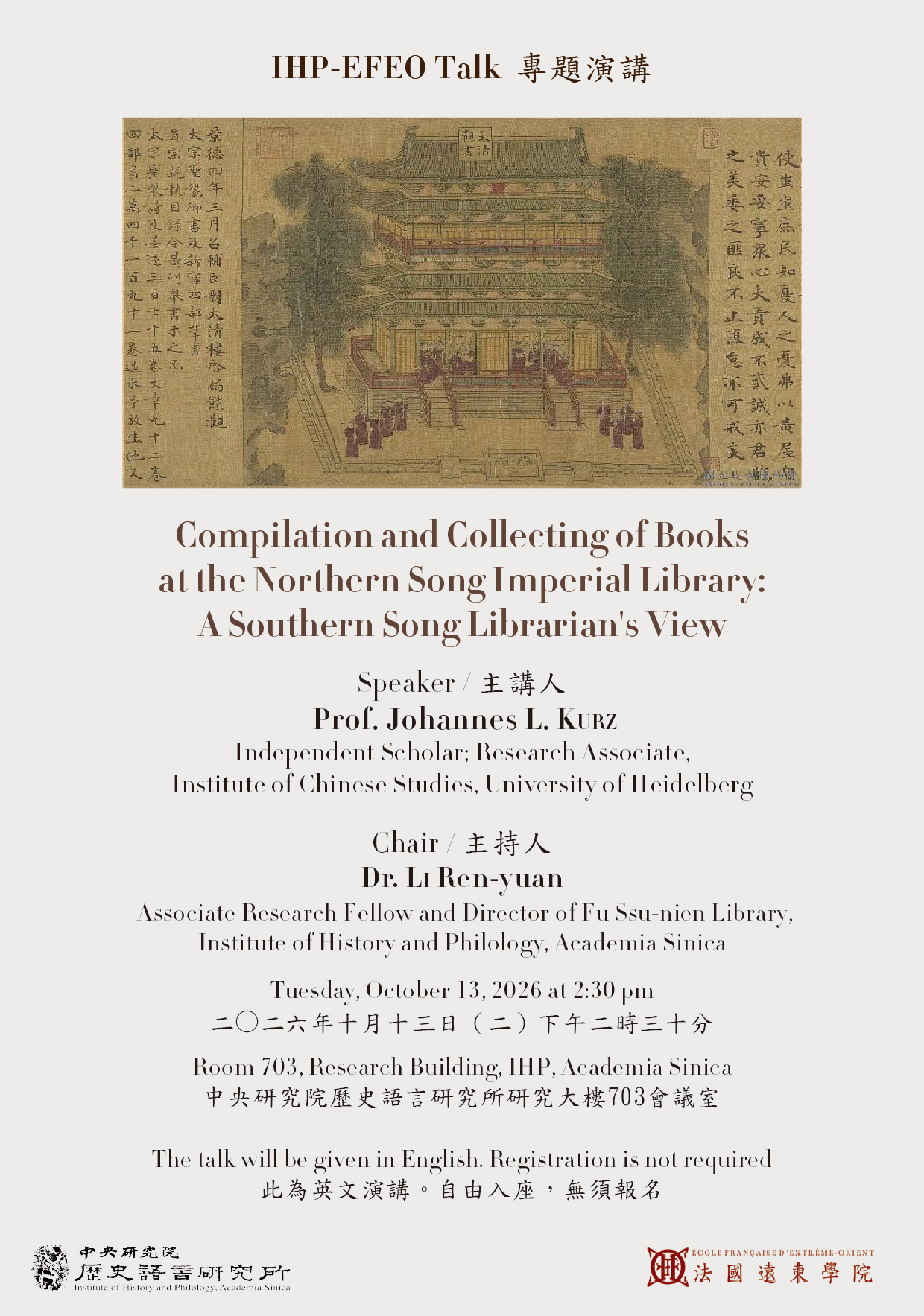
SpeakerJohannes L. KURZ
Compilation and Collecting of Books at the Northern Song Imperial Library: A Southern Song Librarian's View
Time2026-10-13
Location研究大樓703室
-
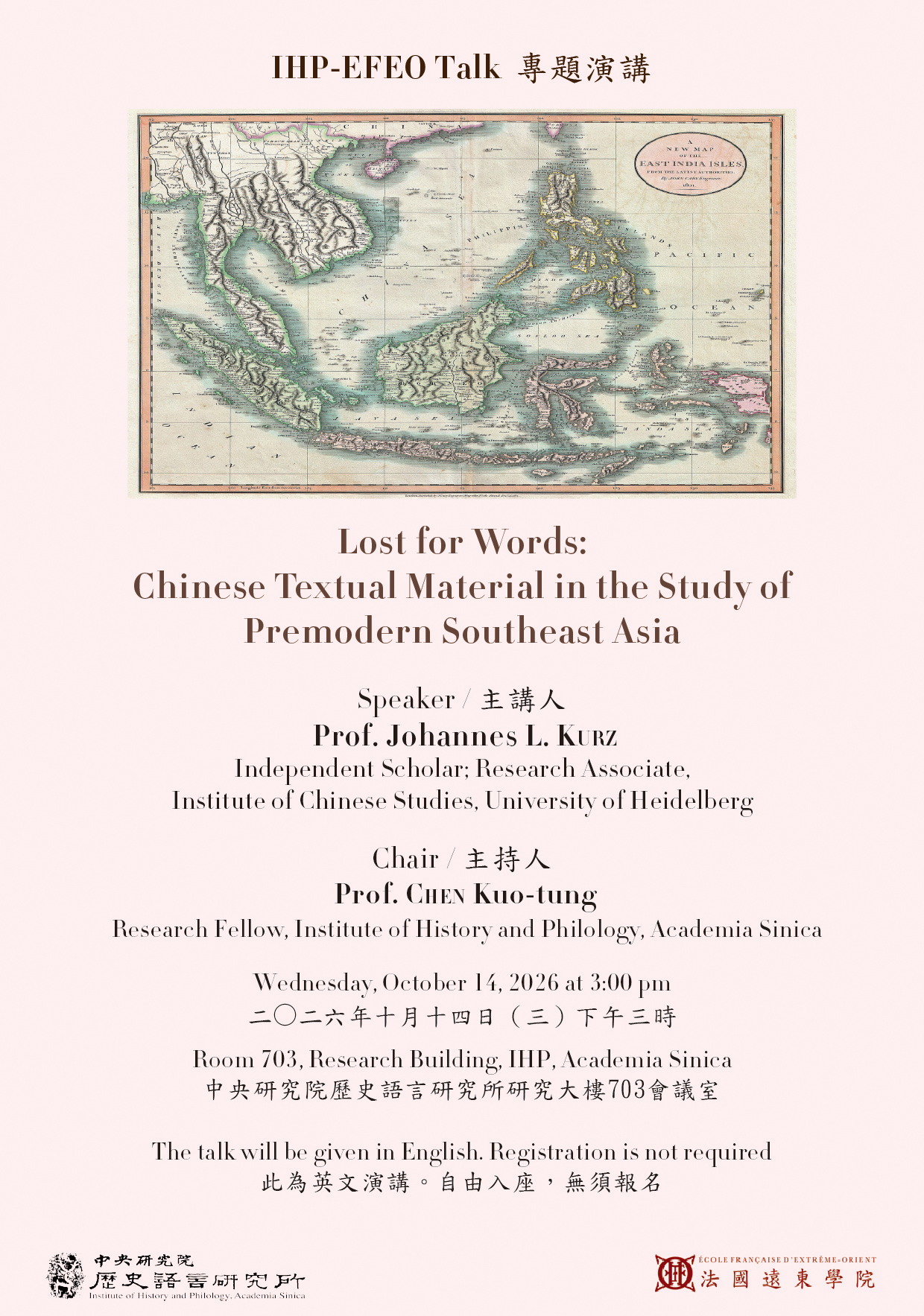
SpeakerJohannes L. KURZ
Lost for Words: Chinese Textual Material in the Study of Premodern Southeast Asia
Time2026-10-14
Location研究大樓703室
-
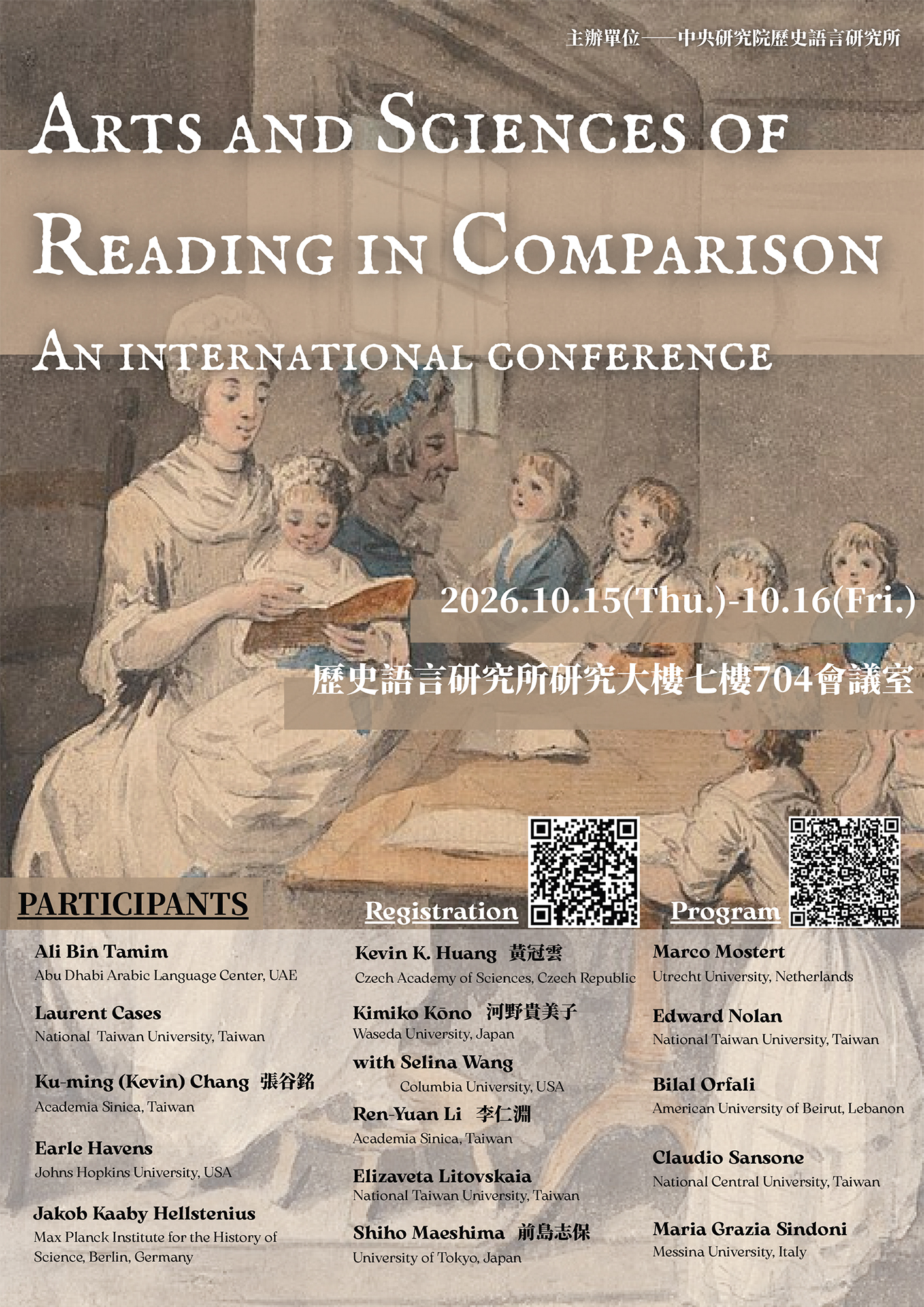
Speaker
Arts and Sciences of Reading in Comparison: An International Conference
Time2026-10-15
Location研究大樓704室
-
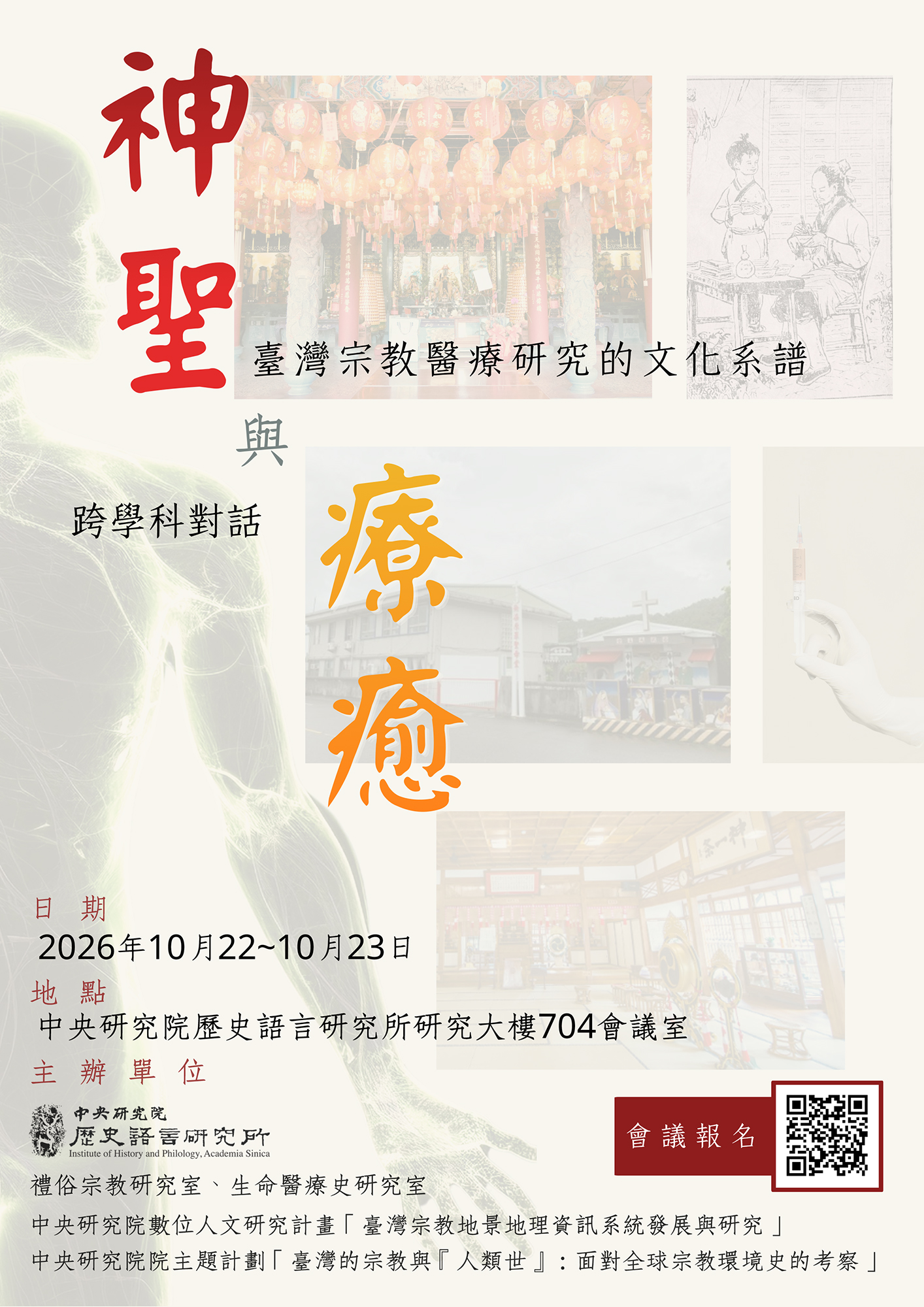
Speaker
Healing and the Sacred: Cultural Genealogies and Interdisciplinary Dialogues in the Study of Religious Healing in Taiwan
Time2026-10-22
Location研究大樓704室
-
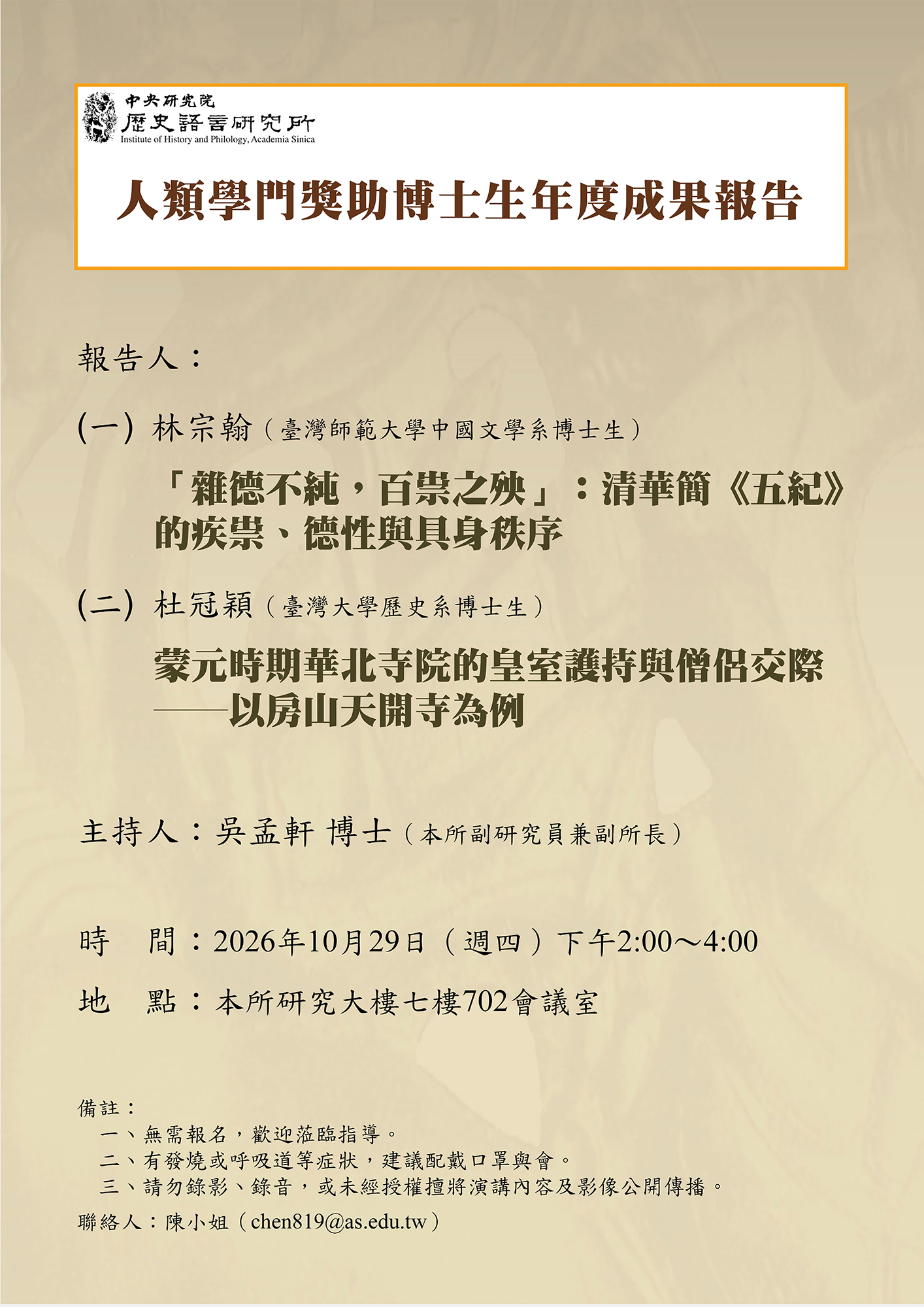
Speaker林宗翰、杜冠穎
Annual Final Presentation for Recipients of the PhD Scholarship in Anthropology
Time2026-10-29
Location研究大樓702室


